
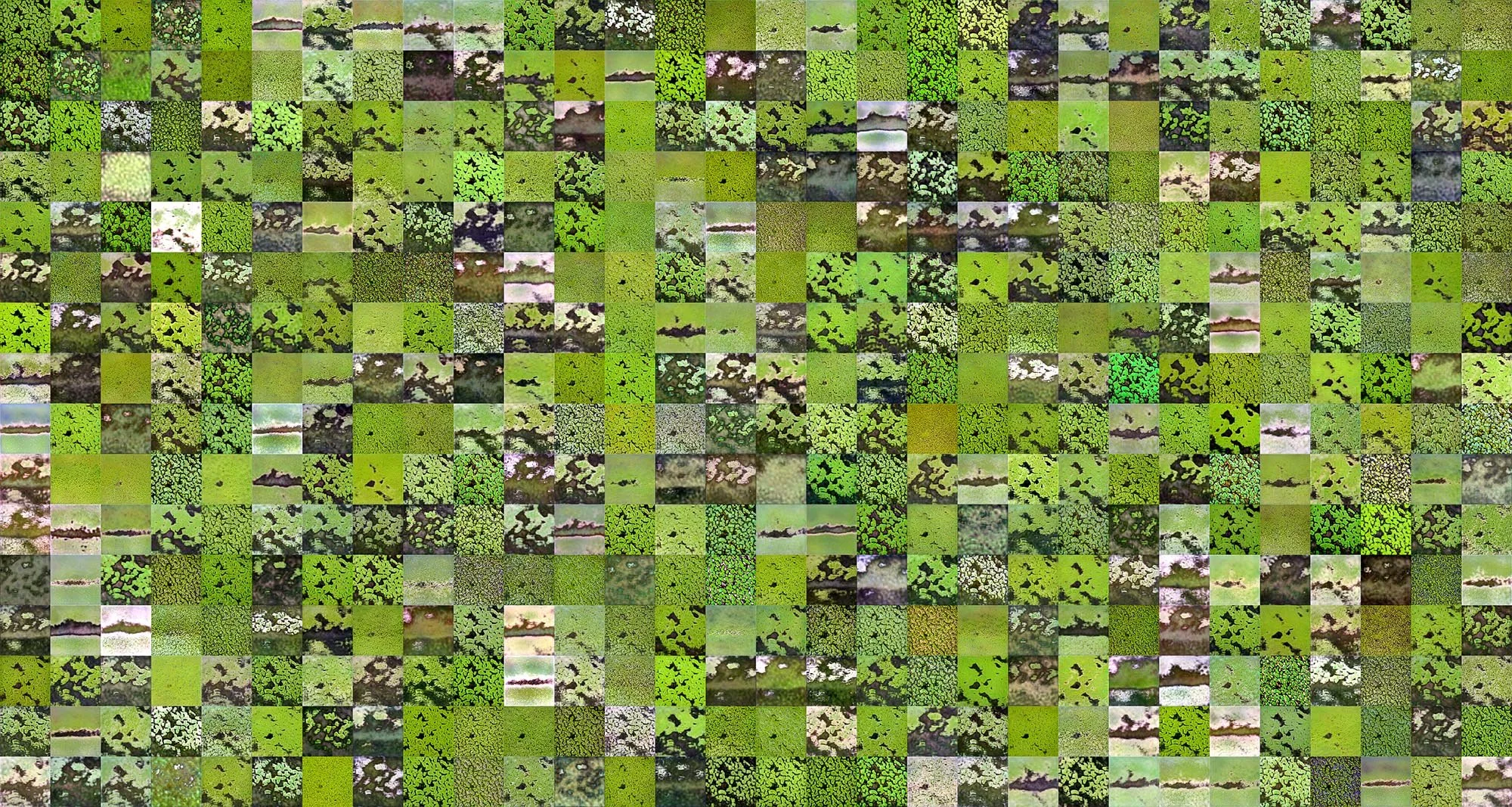
This section of the blog documents an ongoing research-creation project exploring generative adversarial networks (GANs), latent space, and ecological ways of working with machine learning in art practice.
Rather than treating AI as a tool for instant image production, this project approaches model training as a form of fieldwork and attunement. Datasets are gathered through walking, drawing, photographing, and speculative making; practices I think of as data gleaning. The model learns not what these images mean, but how their patterns, textures, and densities relate, forming a latent space of potential forms.
I understand the latent space as a kind of speculative wetland: a continuous terrain where images morph, blend, and become-with one another; duck to pond, pond to glyph, glyph to abstraction. Sampling from this space feels less like retrieving images and more like releasing spores: cultivating conditions from which new visual phenomena can emerge.
How might we work with machine learning in ways that emphasize relation over extraction, care over speed, and situated practice over universal claims? What kinds of ecological imaginaries do these systems reproduce and where might they open space for other futures?
Here, I will share field notes from this process: reflections on datasets and training, slowness and failure, technical constraints and conceptual drift, alongside the images and questions that arise. This is an experiment in tending a small, computational ecology within the rhythms of a rural studio.