On Slowness, Constraints, and Learning to Wait

Working with GANs is often imagined as fast, automated, and frictionless. In practice, it is slow, material, and full of constraint.

Before any image can be generated, time is spent curating the dataset; selecting images that hold both difference and coherence. Too much sameness and the model collapses into repetition; too much variation and it loses its sense of form. This process can take days: gathering, sorting, resizing, naming, and composing with what belongs together.

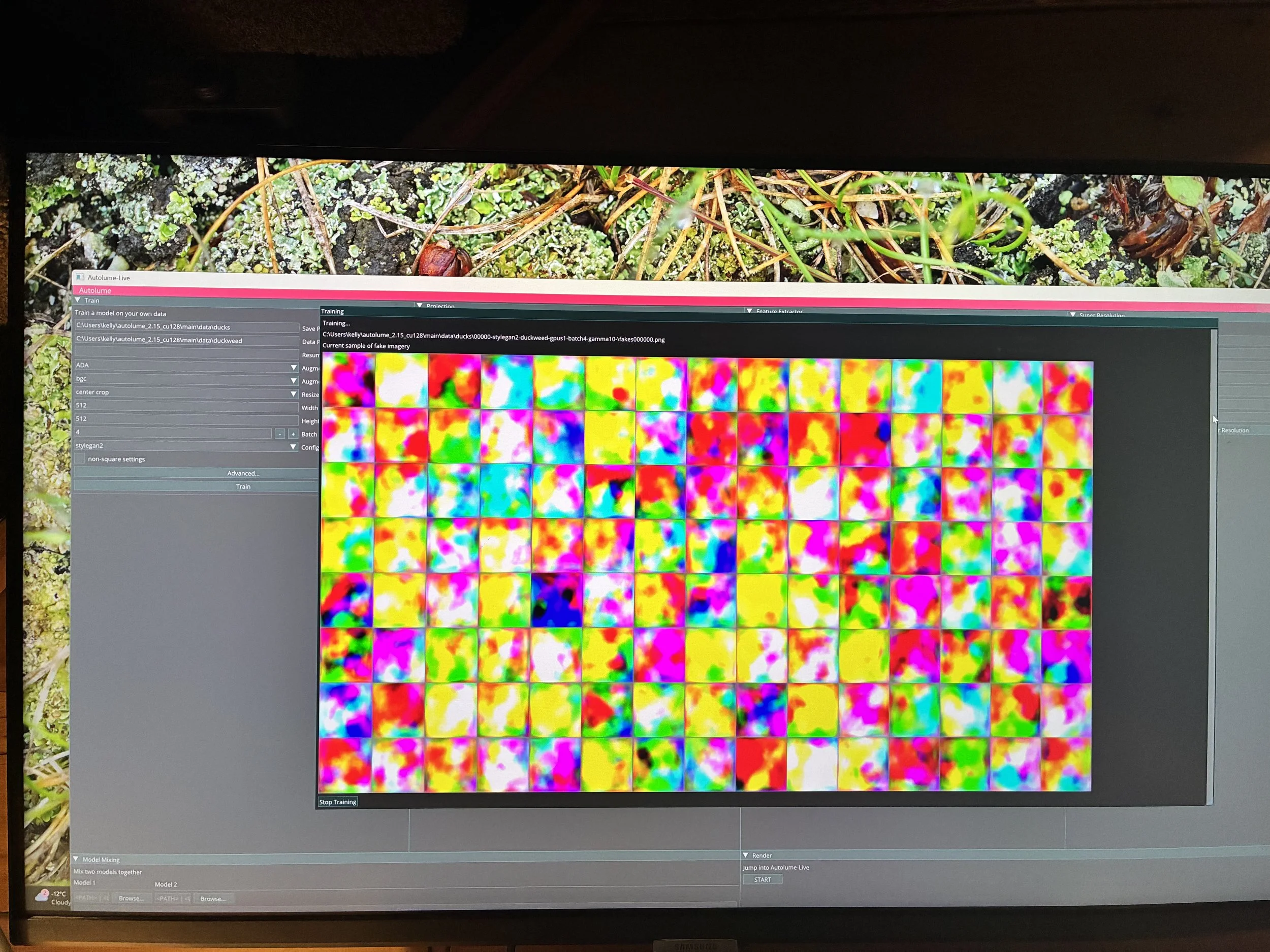
Then come the limits of the machine itself. Batch size, image resolution, and model architecture must be tuned to what my GPU can hold without crashing. These are not abstract parameters but negotiations with heat, memory, and capacity and reminders that this “learning” is grounded in very real, very finite hardware on my desk.

Training is slower still. Once started, it may run for hours or days, with no guarantee of success. Progress reveals itself gradually: a blur becomes a form, noise begins to hint at structure. There is no rushing this. The system learns in tiny increments, and I learn alongside it; when to stop, when to wait, when to let it keep becoming.

This slowness demands patience and care. It resists the fantasy of instant output and instead aligns more closely with practices of fermentation, composting, or ecological growth. Like SCOBYs, lichens, or pond ecologies, the model needs time to attune to its conditions. Intervention is possible, but only within rhythms that cannot be forced.

In this way, the process itself becomes a quiet counter-narrative to extractive AI: one that values tending over acceleration, attunement over efficiency, and waiting as a form of work.
Work in Progress: Water Lentil is the Fancy Name for Duckweed

Speculative ecologies, decoy systems, and machine dreaming

Water Lentil is the Fancy Name for Duckweed is an ongoing research-creation project exploring speculative ecologies at the intersection of DIY bio-culture, environmental remediation, and generative machine learning. The project takes its name from duckweed’s rebranding as “water lentils” in a shift that gestures toward the ways humble, weedy organisms are reframed within contemporary narratives of green innovation, sustainability, and techno-solutionism.

At the centre of the work are a series of sculptural “growth units,” systems, and media installations that resemble domestic or small-scale bioremediation devices. These fictional apparatuses borrow from the aesthetics of aquaculture, hydroponics, backyard science, and startup green design, while quietly unsettling the promise that ecological repair can be engineered, optimized, and commodified.

Alongside these sculptural forms, the project engages generative adversarial networks (GANs) trained on gathered images of ducks, duckweed, ponds, decoys, and speculative drawings. Through a practice I call data gleaning, datasets are assembled from walking, observing, photographing, and drawing in local wetland environments, as well as from constructed decoy forms within the studio. The resulting images do not document these ecologies but conjure them; producing uncanny, plausible, and impossible wetland organisms that hover between care and simulation.

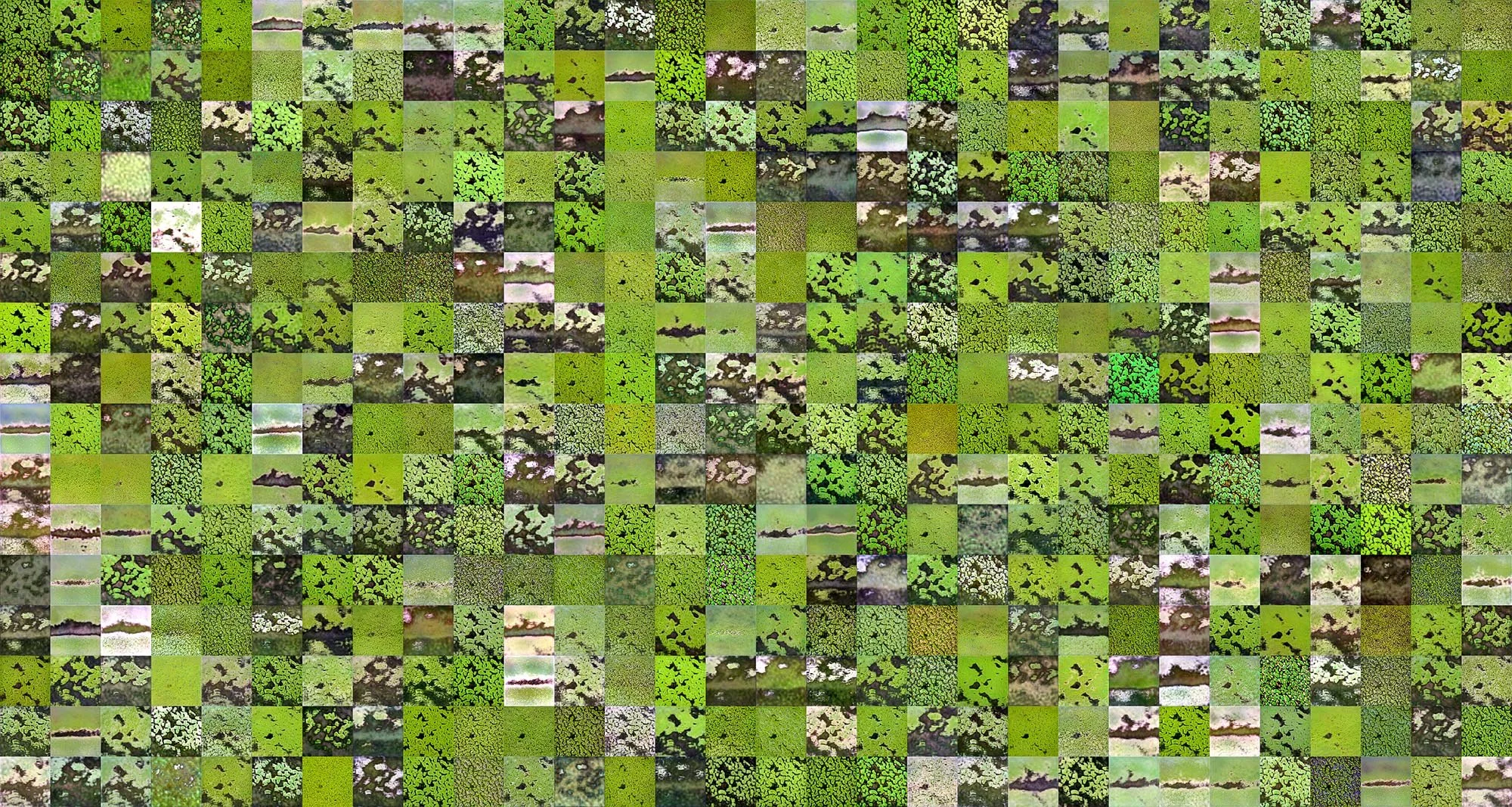
The GAN’s latent space becomes a speculative pond: a computational ecology where forms drift, merge, and mutate. These generated images, printed as part of the Decoy series, act as visual companions to the sculptural growth units and suggest future wetlands that are at once fertile, artificial, and unresolved. Together, the works ask how ecological imaginaries are shaped by both grassroots DIY culture and extractive green capitalism, and where artistic practice might open space for other ways of sensing, waiting, and tending.

The project approaches both living systems and machine learning as sympoietic processes or worlding practices that emerge through relation rather than control. Duckweed, microbes, water, plastic decoys, sensors, and neural networks are treated not as tools, but as collaborators in a shared speculative ecology.

This blog documents the project as a living process: field notes from latent ponds, reflections on slowness and failure, training logs, material experiments, and conceptual drift. It is a space to think with wetlands; both biological and computational, while tracing how decoy systems might become sites for care, critique, and more-than-human imagination.

This project is generously supported by the Alberta Foundation for the Arts, whose funding is enabling the development and presentation of this work as part of its next phase.

Decoy Dataset I - 8 different ducks (20 images each) in an inflatable hot tub.

Project Introduction: Wetlands of Latent Space

This section of the blog documents an ongoing research-creation project exploring generative adversarial networks (GANs), latent space, and ecological ways of working with machine learning in art practice.

Rather than treating AI as a tool for instant image production, this project approaches model training as a form of fieldwork and attunement. Datasets are gathered through walking, drawing, photographing, and speculative making; practices I think of as data gleaning. The model learns not what these images mean, but how their patterns, textures, and densities relate, forming a latent space of potential forms.

I understand the latent space as a kind of speculative wetland: a continuous terrain where images morph, blend, and become-with one another; duck to pond, pond to glyph, glyph to abstraction. Sampling from this space feels less like retrieving images and more like releasing spores: cultivating conditions from which new visual phenomena can emerge.

How might we work with machine learning in ways that emphasize relation over extraction, care over speed, and situated practice over universal claims? What kinds of ecological imaginaries do these systems reproduce and where might they open space for other futures?

Here, I will share field notes from this process: reflections on datasets and training, slowness and failure, technical constraints and conceptual drift, alongside the images and questions that arise. This is an experiment in tending a small, computational ecology within the rhythms of a rural studio.