




Automata for Colour II
Action Art Actuel, Saint-Jean-sur-Richelieu, QC
Water remembers. Colour wanders. Systems breathe.
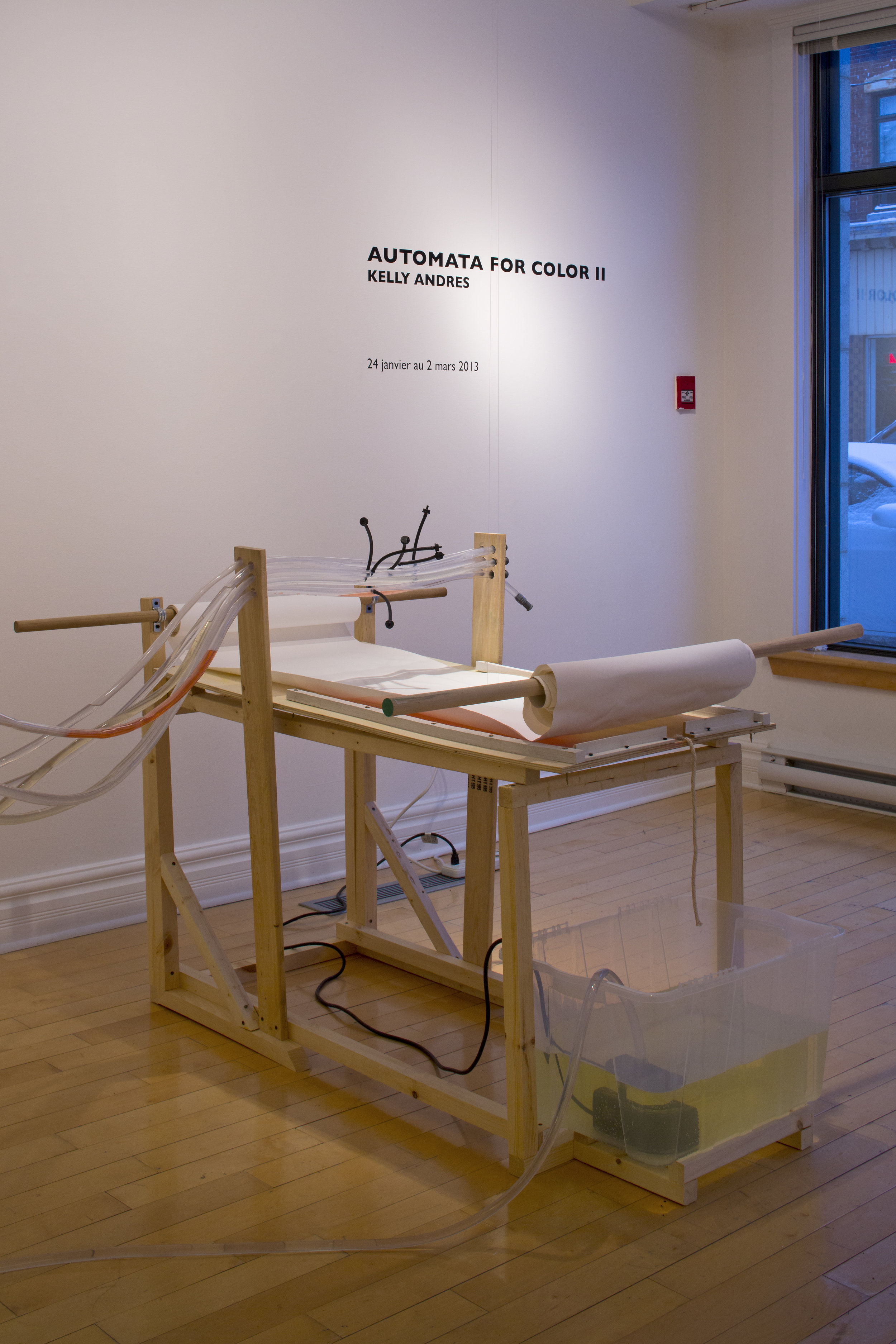
Automata for Colour II is a sculptural ecosystem in which water, pigment, flora, tubing, and electronic components perform a slow choreography of circulation, seepage, and transformation. The installation asks what happens when leakage, so often framed as failure, becomes a generative force, a carrier of memory, a threshold through which matter drifts into new forms.
In this work, colour behaves like data: diffusing, staining, accumulating, fading. Clear vinyl tubing carries dyed water through a network of vessels, catch basins, pumps, and valves. Plants draw pigment upward through transpiration, only to release it again as it spills, evaporates, or bleeds into adjacent chambers. Over time, the system muddies itself, cycling water and colour through imperfect filtration processes that refuse purity in favour of ongoing mutation.
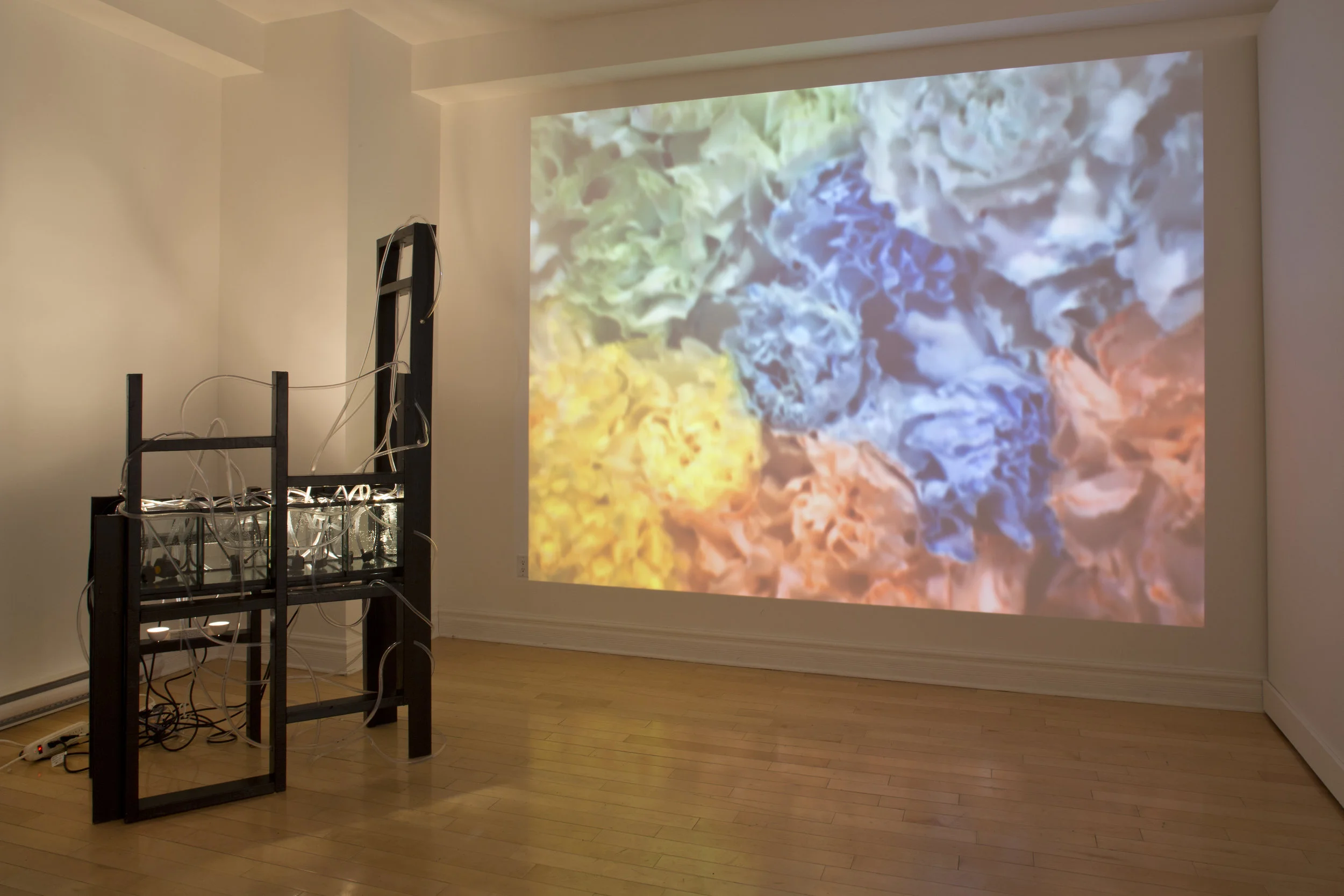
The installation operates as a kind of neuro-semiotic habitat, as a distributed environment where pumps, timers, drip gauges, flora, and evaporation collaborate to produce emergent behaviour. It is neither fully mechanical nor entirely biological, but something in-between: a porous apparatus that reveals how boundaries blur across bodies, media, and materials. A live timelapse camera monitored the shifting pigmentation of the flowers throughout the exhibition. The footage was projected into the adjacent room, transforming each petal into a temporal screen and a record of colour moving through plant cells.
The term automata is used critically. Rather than depicting a closed, predictable machine, the work proposes an unruly, breathing system; alive with gradients, delays, imbalances, and continual renegotiations of flow. Influenced by systems-based practices such as Hans Haacke’s Condensation Cube and early eco-aesthetic experiments, Automata for Colour II explores material processes as dynamic conversations rather than as outcomes to control.
At its core, the installation invites viewers to consider leakage not as loss, but as a passage:
a transition between states, a becoming, an event in which colour, water, and vegetal bodies temporarily share themselves with the world.
{…[Primary colours must become secondary.
A document runs in a pattern of one colour a day or what consists of sun-up-moon-down.
Colour is systematically removed from the system through transpiration into secondary storage. Traces of previous data become absorbed into the document.
Water is a conduit.
Residue is a memory.
Data is colour.
Cells act out as strange storage.
The document reveals a residue of data as it performs through the system. External variables can be defined as the following:
Duration, lapse, cyclical events, reabsorption.
The document can be refreshed every week but this is not a rule.
Duration is expressed as a series of leakages.
Leakage is some kind of hope, not entirely unproblematic. Something towards a poetic event after-time. The system will reveal an inevitable compounding effect. This is unavoidable. This could be described as noise, but, really it is just a decline into shades.
Shades are the mature state of this system: An evolution of sorts?
This behaviour is not predefined, although, it is expected.
If the artist was a plumber, the system would be nearly perfect.
If perfection could be defined as something that has a sense of autonomy — or is self-restorative, or self healing, or self governing?
If I was an engineer of aqueducts this statement would be more interesting or ridiculous. It may not exist.
Transmission occurs when the petals begin to resemble a liquid screen, reabsorbed and reflected in a surface that appears to be bound to a nowness…] }