

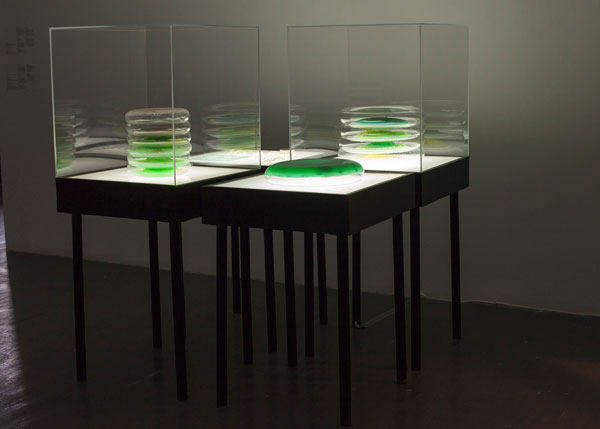


The Temporary Archive of Ambiguous Architecture
2012–2015 | Multi-part installation | 3D printing, agar cultures, fungi spores, sensors, PLA vessels, light tables, video
Les Territoires, Montréal, QC, Photo credits: Alison Reiko Loader
One longstanding strategy within contemporary art is to juxtapose the name of an artwork with a material configuration in order to unsettle the cultural authority of that name. With The Temporary Archive of Ambiguous Architecture, I worked deliberately with the concept of the “archive”, a term that carries connotations of stability, preservation, taxonomy, and control, and reimagined it through materials that grow, rot, mutate, and refuse permanence. These living archives were staged using the visual language of object preservation, sterile glassware, plinths, vitrines, dimmed lighting, illuminated bases, while the material systems inside them actively destabilized the very idea of the archive as fixed or authoritative.
By pairing conceptual inquiry with material enactment, the installation asks how an archive behaves when its contents are volatile, symbiotic, or alive. What happens when an archive generates its own narratives, outgrows its containers, or decomposes its housing? What becomes of an “object” when its identity emerges through duration rather than historical capture?
Across four iterations, the project expanded into a series of experiments in which 3D-printed geometries, fungal spores, agar-agar substrates, and environmental sensors collectively composed an archive that was always in flux.
Archive I: Math and Mycelium
A modified RepRap 3D printer was reconfigured to print agar gel infused with mycelium spores. A piezo microphone sensed vibrations in the room—footsteps, movement, ambient activity—triggering the printer to extrude a simple geometric line or layer. This act, echoing mycelial sensing in soil, linked human presence to fungal becoming. As the spores colonized the printed forms, the living growth dismantled the mathematically ordered space of the Cartesian grid, adding a temporal, unpredictable fourth dimension to the printer’s x–y–z logic.
Archive II: Fractal Vessels and PLA Decomposition
A set of 3D-printed vessels—modelled from mycelium patterns, fractals, and geometric sequences—were displayed on light tables as luminous architectural artifacts. In later versions, these towers were filled with inoculated substrate to test how fungal growth could physically transform, soften, or decompose the PLA plastic structures themselves, revealing an architecture performed through decay and multispecies agency.
Archive III: Still … Life
A video work created through DIY 3D scanning and open-source animation tools documented the process of making the installation. The film reflects on layers of instrumentalization—measurement, modelling, architectural visualization—and interrupts these traditions through vibration-triggered printing and the speculative semiotics of spore-led mark-making.